
An Influencer Marketing Framework
Influencer marketing looks like a job of casting influencers and creators, but the questions that remain after a campaign are mostly about standards. We cannot say, by the same yardstick, what worked, where it got stuck, and what to change next time, so evaluation differs from person to person and the learning does not carry over to the next campaign. I believe that yardstick is a framework.
An influencer is a means, not an end. Because every influencer's message is different, it is hard for a brand to control the expression closely, and without a standard, selection narrows to follower count and fee, and evaluation narrows to views. You need a framework that connects diagnosis, design and evaluation, starting from the goal, before you can explain why you chose an influencer at all.
Combining CDJ and Messy Middle
The CDJ (Consumer Decision Journey), introduced by McKinsey in 2009, was presented as an alternative to the funnel and became an established marketing framework. It divides the consumer's journey into four stages: initial consideration, active evaluation, purchase and post-purchase experience. Because of that, there is no better standard for telling, stage by stage and by metric, where things fall short. But it does not cover what tips a consumer's choice inside those stages, and in practice the stages are often used as if they flowed in one direction.
Messy Middle, published by Google in 2020, describes exactly that stretch as a loop. Consumers move back and forth between exploration (widening the options) and evaluation (narrowing them), and what tilts this loop is six cognitive biases. In contrast, it is hard to measure how many times the loop turns during exploration and evaluation, and hard to set KPIs by stage.
In this sense the two models fill each other's gaps. CDJ divides the consumer's journey into stages and diagnoses where it is stuck, while Messy Middle, based on which biases consumers respond to in the explore-evaluate loop, tells us what content to put in that spot. Combined, a CDJ diagnosis such as "response at the active evaluation stage is low" turns directly into a question: which bias should we use to fix the message? Trunk combines these two models and uses them as its framework for influencer marketing.
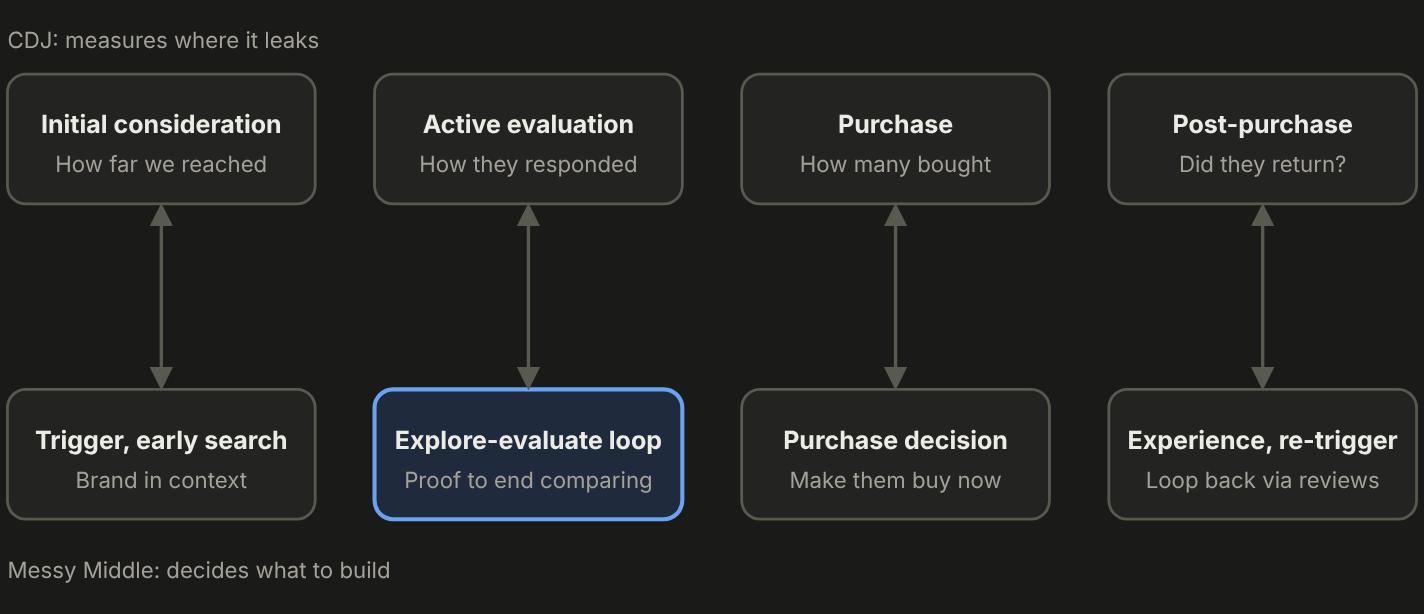
Applying it to influencer marketing
In influencer marketing, this framework answers three questions. What is the goal of this campaign? Where is the consumer stuck right now? And based on which bias, which strategic approach will we choose for that spot? Here the six biases become the basis of the strategy and a message guide for each stage: category heuristics (a short, clear summary of the key specs), Power of Now (appeal that weakens the longer one waits), social proof (others' recommendations and reviews), scarcity (desire that grows as stock or time runs out), authority (verification by experts and institutions), and Power of Free (the strong pull of a free gift).
What matters is that more than one bias can be used for a single bottleneck. Which bias you choose changes the brief and the casting, and that choice is the strategy. Once the bias is set, you can see which influencer fits, and once the stage is set, you can see what to check.
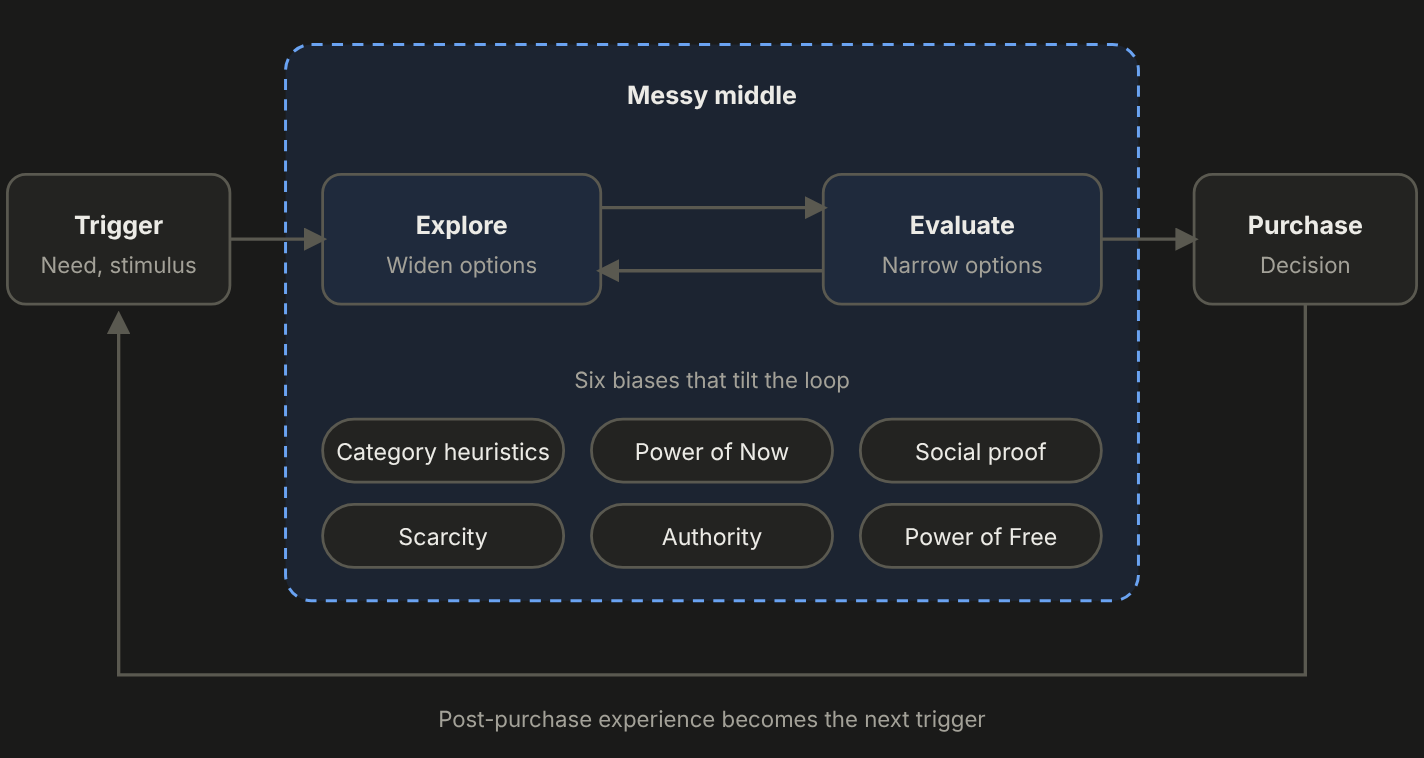
Example: a new brand's early market entry, seen through the framework
Let me reread the case from my earlier piece, "Influence Comes from Taste," through this frame. A foreign street fashion brand was entering Korea, and the goal was not exposure but securing the core target who could represent the brand in its early launch. In terms of marketing purpose, it is brand marketing that builds an asset.
Few people in Korea knew the brand at the time, so the bottleneck was initial consideration. Several biases were available at this stage. You could create scarcity with limited quantities, or build social proof by collecting reviews. Read through this frame, the choice in this campaign was authority. The people who wear the brand's signature oversized fit best were professional dancers in the dance community, and no signal is stronger than the fact that those people wear it. On top of that, the single line "the fit dancers wear" worked as a category heuristic, standing in for the core spec. The influencers were also drawn from inside the dance community, and the brand took its place as "the clothes street dancers actually like to wear," talked about naturally within the community.
Going one step further, the next bottleneck would be active evaluation. Even when its name comes up inside the community, an oversized fit is clothing you have to try on to judge, so consumers need a place to finish comparing. This time social proof fits. If visitors can try the clothes on at a pop-up and see dancers wearing them on the spot, that becomes the evidence that ends the comparison. This is at the idea stage. If you choose scarcity at the same bottleneck, it becomes a very different design, a limited-quantity pop-up, and either way, choosing one bias is choosing a strategy.
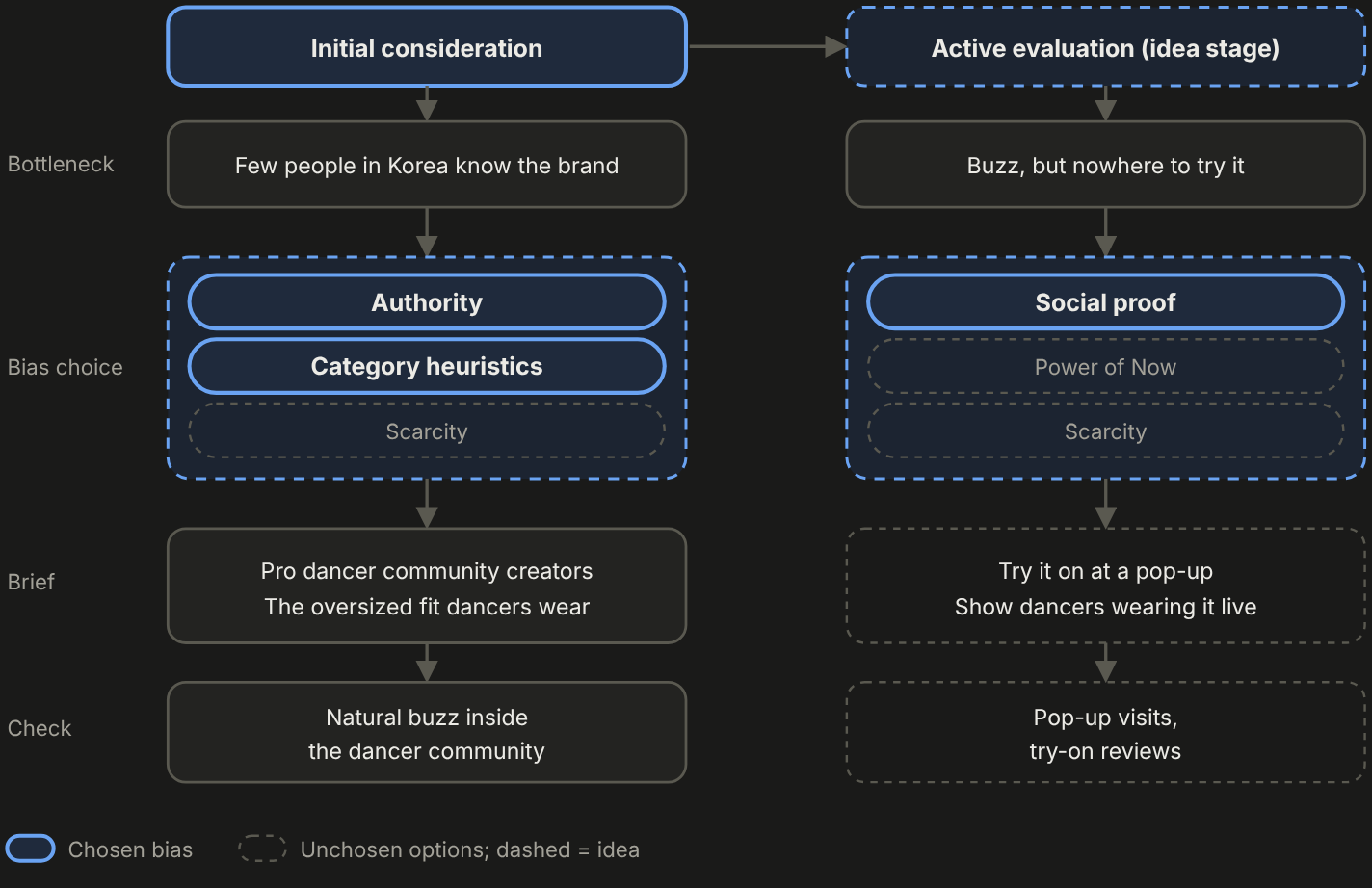
What happens if we spread this two-stage case across all four stages? Below is a summary for a K-beauty brand that is just entering the U.S. (a hypothetical). The same influencer is not used at every stage. For each stage, the casting, bias, brief and check metric are set separately to fit the bottleneck.
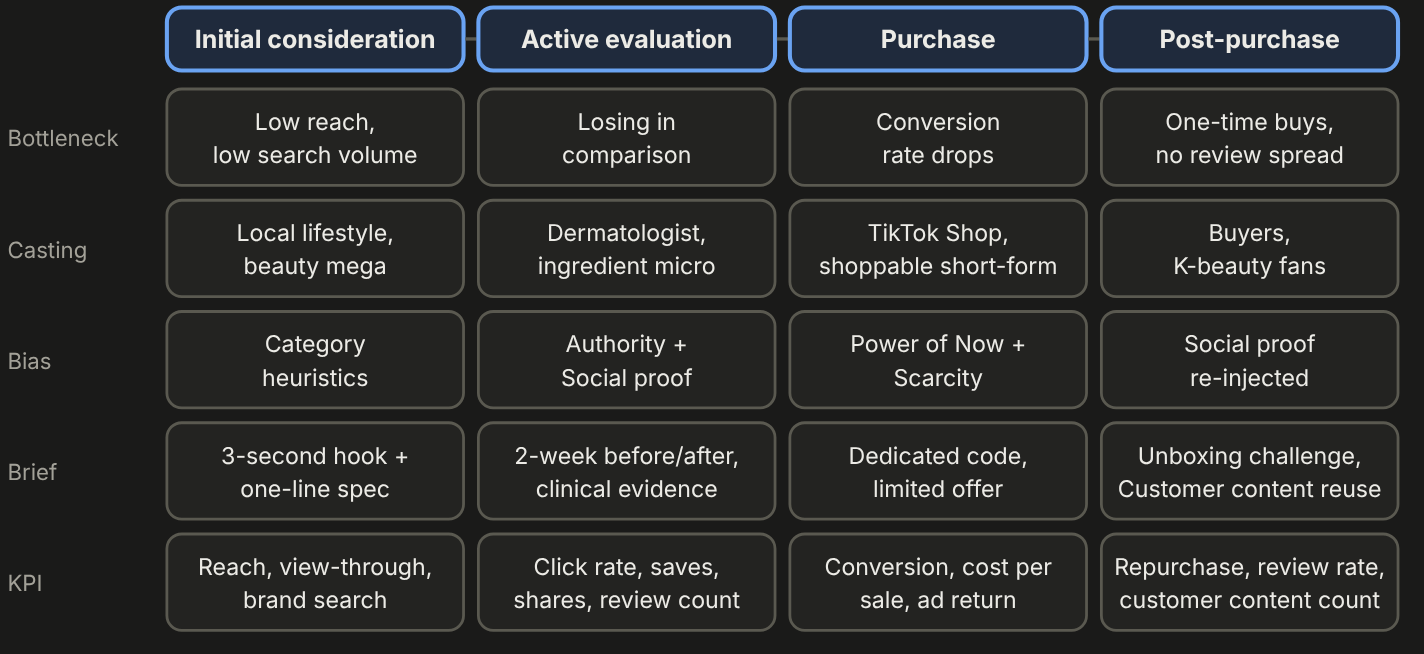
Laid out like this, the framework becomes one cycle of setting strategy, evaluating, revising and monitoring. Strategy comes from diagnosing the bottleneck at each stage, choosing a bias, and writing the brief. Evaluation is checking the result against the KPI of the same stage, and revision is changing one bias or one casting choice in the box where the KPI is low. Monitoring continues by watching the same box by the same standard in the next campaign.
The limits and benefits of the framework
The limits are clear. The stage divisions are only boxes for diagnosis, and real consumers cross between stages. So we use the boxes of CDJ not as the path consumers walk but as a map for finding where we are stuck. Messy Middle was not built to measure performance, so quantification falls to CDJ, and because price is missing from the study design, categories where price competitiveness matters cannot be explained by biases alone. On short-form feeds such as TikTok or Reels, where the trigger and the purchase are joined, the loop has to be compressed.
Even so, I think it is better to carry a framework, because the benefits outweigh the limits. With a framework you can set a hypothesis and test it, and compare against your own earlier campaigns or competitors within the same frame. Because each campaign is judged by the same questions, the reasons for success and failure remain on record, and what to change in the next brief narrows to one thing. Even if the frame is wrong, you need a standard to see where it is wrong. Before the campaign, though, measure a baseline such as brand search volume first; otherwise you cannot say what improved.
Before you write your next brief, try asking this: "At which stage is our brand stuck now, and which bias will we choose for that spot?"
Trunk helps brands run influencer marketing campaigns with this framework.