
Creator vs. Influencer: How Should We Approach Them?
Recently I had a short conversation about influencer marketing with a Korean manufacturer. They were looking for a fresh way to reach the younger generation in North America. Industrial-type products like theirs are hard for an influencer to present in a new light. Tires are the classic example.
I believe that for brands like this, the first place to look is making something together with a creator, before turning to an influencer. I am not saying that B2B-leaning products should work with creators. I am saying that when a product is hard to promote as it is, one option is to choose a partner who can turn the product's core appeal into a work of their own.
Creators and influencers are used in different places
As often as you hear the word influencer, you hear "creator economy." It refers to an economy in which creators make content, products and services and deliver them straight to an audience through platforms, and it is also called the influencer economy. Goldman Sachs projects that this market will nearly double, from about $250 billion in 2024 to about $480 billion in 2027.
Inside this economy, everyone from influencers to bloggers is called a creator. In influencer marketing, though, it is more strategic to look at the two separately.
A study released in October by Syracuse University's Center for the Creator Economy offers one clue. In a survey of 989 U.S. adults, 83.7% named dedication to a long-built craft as the standard for a creator. 66.7% also said creators and influencers are different. The study combined 40 interviews with a survey of how people perceive them. It does not show that either side performs better.
My view is that people draw this line because a creator has a body of work. Creators spent years making work like craftspeople, and that work is how they gathered their community and followers. Influencers take a primary product that already exists, process it into content as a secondary work, and carry its meaning and value through their reach.
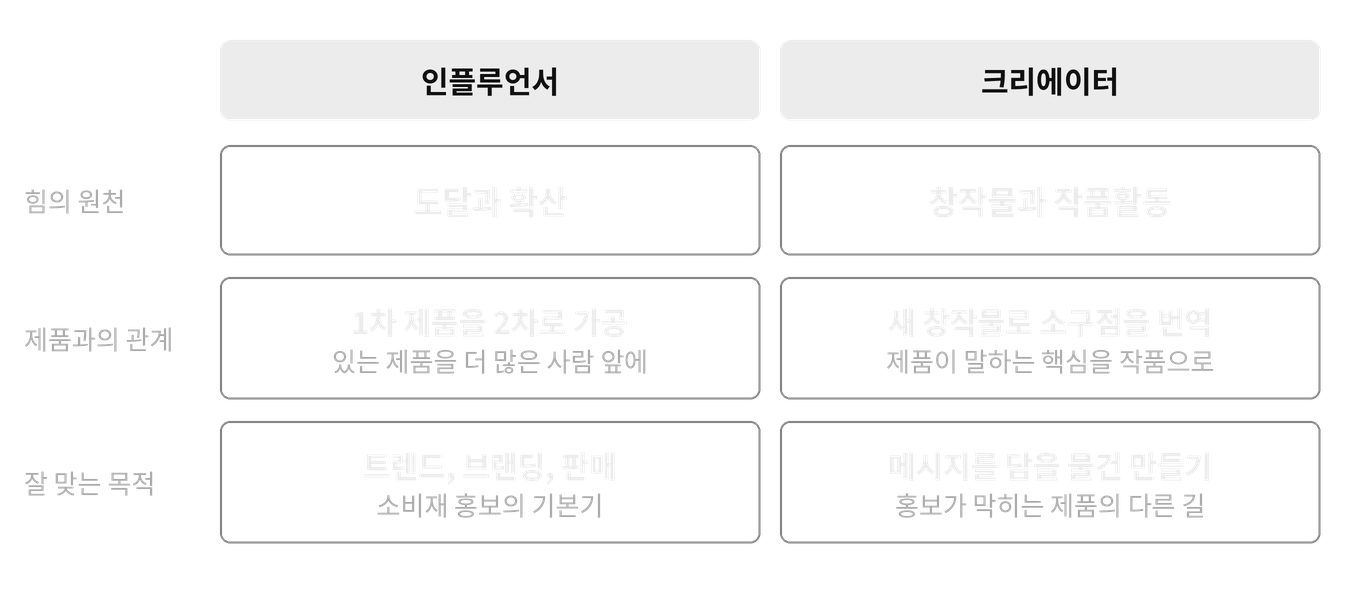
Because the work is different, so is where each one is used. Influencers shine in trends, branding and the point of sale. For consumer goods, an influencer is usually enough. This is not to say creators are better. It is about choosing the one that fits the goal.
The limit set by the primary product
An influencer's strength lies in how creatively and attractively they present the primary product. The range of secondary processing is wide, but it is shaped by the nature of that product, and the limits come from there too.
What an influencer does is put an existing product in front of more people. When a product reaches the consumer's hands directly, this is the most efficient approach. When the purchase decision happens at an intermediate step, the path from reach to purchase gets shorter.
Tires are such a case. There is already a dealer between the tire and the consumer. The dealer plays the KOL role, recommending and explaining, so there is little room for an influencer to present the tire in a new way. Even so, building a brand in North America needs the power of influencers. How to resolve this blockage is the question of this piece.
If the product itself is hard to show, you need to pull out the core appeal the product speaks to. The person who can turn that appeal into a work is a creator.
A tire translated into fashion
This is not an executed case. It is at the idea stage. The essence of a tire is grip. Instead of showing the tire itself, I wondered what it would look like to approach Gen Z with the appeal of grip. I judged that shoes are something that generation takes to easily. So I proposed reworked shoes with outsoles combined with tire rubber.
There is already a good example in this field: Goods & Services (@shopgoodsandservices), a shoe workshop in Los Angeles. Opened in 2019, it reworks sneakers and boots and turns even the rubber of the outsole into a piece of work. Its Instagram includes a project that rebuilt vintage Nike ACG boots with Vibram's Arctic Grip outsoles. It is a scene where an outsole with the word grip in its name becomes a work in itself. My proposal is to put a tire company's rubber in that place.
The message of grip is delivered through a pair of shoes, without explaining it. It translates the tire into the language of fashion. A creator who makes work is best placed to do this translation. Whether or not it gets executed, I think this is an area where a strategic approach with creators is worth considering.
How to approach a creator
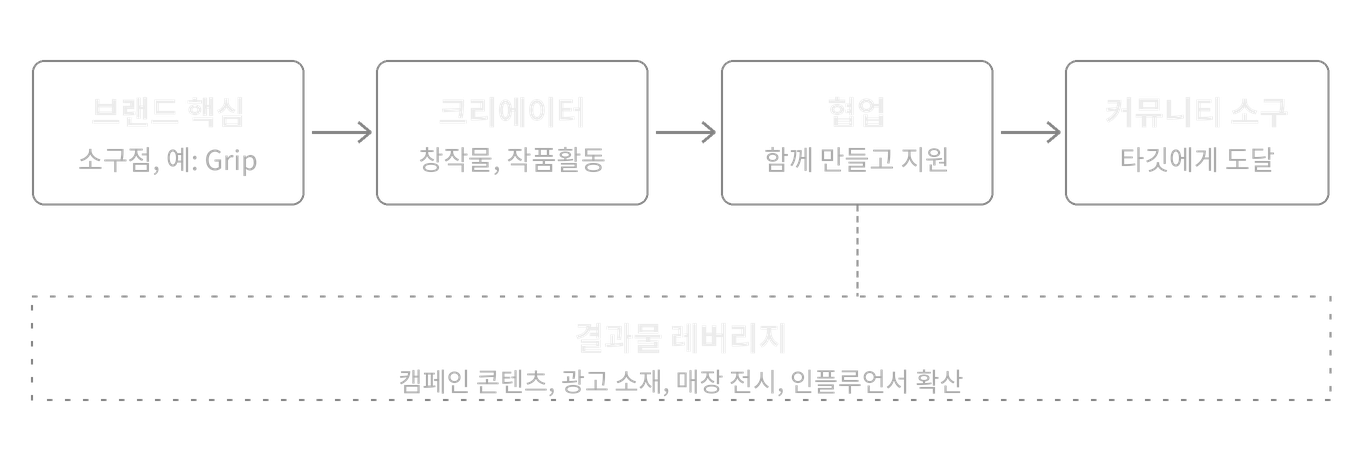
The key is how to connect the creator's work with the brand's core appeal. I see four points:
- Selection. Look at what they have made and for how long, rather than at follower count. The standard is their portfolio, their way of working, and what is uniquely theirs. Check two more things: whether their work connects to our core appeal, and whether their followers are the target we want to reach. Even with many followers, if the target is different, the value of the collaboration drops.
- Join the process and support it. Do not control the expression with a brief. Give the purpose and the lines not to cross, and leave the way of making it to them. In return, the brand takes responsibility for support such as materials, production costs and schedule. The making itself becomes content too. When a creator shows how a pair of shoes is made on their own channel, the brand can build a story before the result even exists.
- Leverage the result. The finished shoes are content in themselves, a work that carries the brand message. They can be the centerpiece of a campaign, an ad asset, or a store display. Before collaborating, consider whether the work can grow into something of greater value.
- Reset the goal. If the goal is reach, an influencer is right. If you need an object that carries the brand message, make it together with a creator. If an influencer spreads the result at the end, the two roles connect.
When this approach does not fit
This approach is not always the answer. Production takes long, and the quality of the result cannot be guaranteed in advance. Because the creator's creative domain must be respected, it is also hard for the brand to control the expression in detail. Whether tire rubber can actually be used for shoe soles needs material verification too. If reach itself is the goal, an influencer is faster and more certain.
The result of this collaboration is a work meant to make the brand known. So rather than judging by reach alone, look at how much it is saved and shared in the creator's community, and whether the message reached the target we want to appeal to.
Creation leads to collaboration, and the result makes the brand known. Working with a creator is not sponsorship. It is a collaboration.
Before looking for a partner, try asking this: "Do we need a creator, or an influencer?"
Sources: Goldman Sachs Research, "The creator economy could approach half-a-trillion dollars by 2027". Syracuse University Center for the Creator Economy, "Creator, Defined" (released October 2026; survey of 989 U.S. adults and 40 interviews). Goods & Services Instagram @shopgoodsandservices.
Trunk (trunkand.com) is a GTM agency that helps Korean brands enter the U.S. through influencers.